Real-Time Inventory
Inventory wasn't just a workflow gap or a missing feature.
Enterprise prospects expected it, and expected it to connect with purchasing and project workflows, while existing customers were using spreadsheets or other software because the product did not give them a trustworthy source of truth.
We designed Inventory Management into a real-time, unified inventory system spanning projects, locations, and purchasing, reducing manual reconciliation, improving accuracy, and helping drive an 18% increase in recurring revenue.
Problem
Every week, project managers spent hours reconciling stock counts across spreadsheets or jumping between different software. Sometimes, equipment went missing because nobody could trust the numbers. And enterprise prospects expected integrated inventory before they would sign — so the gap was also a sales blocker.
Objectives
- Eliminate manual tracking and errors
- Eliminate dependency on additional software
- Automate alerts and reorders
- Integrate with purchasing/projects
Research Insights
I started by understanding what the user's workflow actually looked like. This could be the user jumping between Cloud and a spreadsheet or Cloud and another software they're paying for, just for inventory. One power user maintained a master spreadsheet with 14 tabs: one per project, plus cross-reference sheets, reconciliation logs, and a manual low-stock tracker highlighted in yellow. It took her two hours a day to keep current, and decisions were still made from stale data.
Across 6 user interviews and workflow mapping sessions, the pattern was consistent:
- Time sink: 2–3 hours/day reconciling stock; user-reported roughly 15–20% error rates
- User split: Small AV shops needed fast confidence in quantities, while larger teams needed asset‑level traceability for accountability
- Market signal: Integrated inventory was table stakes in enterprise deals
Defining Decision
We could have shipped a simpler, spreadsheet-like solution with periodic updates.
Instead, I pushed for a real-time, unified inventory system across projects and locations (such as warehouses, vans, and job sites). While this added technical complexity, it eliminated duplicate sources of truth and ensured teams could trust inventory data everywhere.
Legacy spreadsheet workflow
Some users manually reconciled counts, split data across tabs, and made decisions from stale information.
Money spent on another tool
Most users used another piece of software, like Jetbuilt, to manage inventory. Multiple tools meant more error-prone workflows and extra costs for users.
Unified real-time inventory
A single source of truth surfaced stock risk early, reduced reconciliation, and made decisions faster and more reliable.
Solution Journey
Problems
- Manual spreadsheet reconciliation hid low‑stock thresholds, causing delays and last‑minute emergency buys
- Using external tools like Jetbuilt created fragmented inventory management, leading to higher error risk, duplicated effort, and unnecessary software costs.
How Might We
How might we surface critical inventory risks and eliminate manual reconciliation or the need for more software?
Solutions
- Surface risk: Visual low-stock and incoming-PO indicators on the inventory dashboard
- Automation: PO-driven stock updates and status changes across locations
- Unified system: Eliminated the need for external tools like Jetbuilt by providing a single, reliable source of truth
Captured how spreadsheets or switching between software delayed decisions and concealed stock risk.
Built a single inventory system that reflected projects, purchases, and counts in one place.
Designed alerts and thresholds so low stock became visible before it became urgent.
System model
The core design challenge wasn't just showing inventory. It was defining how inventory changed state across purchasing, receiving, project allocation, location transfers, and asset-level tracking. I worked with PM and engineering to align on a shared model so the UI could explain why an item was available, allocated, incoming, or low-stock instead of showing a flat quantity with no context.
Key decisions & tradeoffs
- Real-time unified model: Chose a single real-time system across locations despite added complexity, ensuring consistent, reliable stock counts everywhere
- Manual reordering (MVP): We intentionally stopped short of fully automated reordering in the MVP because teams first needed to trust the inventory counts and alert thresholds. Automating purchasing before trust was established could have created expensive mistakes, so alerts gave us a safer path to validate behavior before increasing automation.
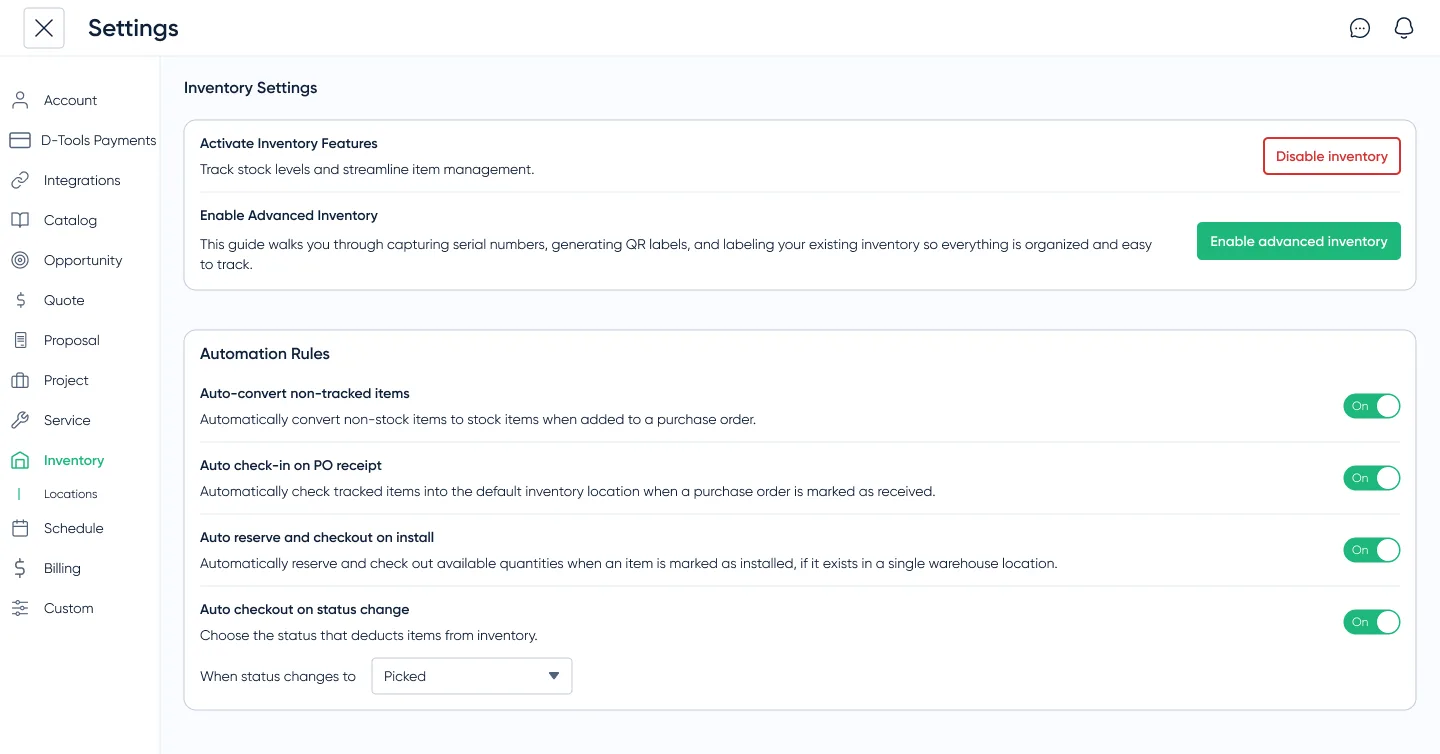
For handoff, I documented how allocations, multi-location states, and receiving/reordering rules affect available inventory, so UI behavior stays consistent as the system model gets implemented. The shared data model was aligned with engineering first, so the UI explains state rather than just showing flat quantities.
Prototyping & Validation
Ran three rounds of high‑fidelity Figma tests to validate receiving, alerts, multi‑location inventory, and reordering flows for clarity and error reduction.
Defining decision: quantity-first by default, asset-level when needed (for larger company users)
Testing showed that smaller teams wanted fast confidence in counts, while larger teams needed specific asset traceability for accountability. I designed the system to stay quantity-first by default, with asset-level tracking available where the workflow required it (also based on settings and permissions). This kept the common path simple without blocking enterprise-level control.
Impact
The system replaced fragmented tracking with a single source of truth, reducing reconciliation time, improving project accuracy, and surfacing unused inventory.
One customer uncovered thousands of dollars in unused equipment, highlighting how much value had been hidden in disconnected workflows.
The release removed a recurring blocker in enterprise sales conversations and contributed to an 18% increase in recurring revenue over the following year.
Lessons & Next Steps
The biggest lesson was that operational products earn trust through state clarity. Users did not just need to know how many items were in stock; they needed to understand why the number was trustworthy, where it came from, and what would happen next.
- Next: Now that teams trust the counts, the natural next step is auto-PO creation from thresholds and mobile scanning, automating the parts we intentionally held back in the MVP.